Concrete Piers vs. Steel Pressed Piers: Which Foundation Repair Solution Is Right for Your Home?
What Are Foundation Piers and How Do They Work?
When foundation problems begin to affect your home, one of the most common repair solutions recommended by foundation specialists is the installation of foundation piers. While the term may sound technical, foundation piers are a proven method used to stabilize and, in many cases, lift settling foundations back toward their original position.
If you’ve recently noticed cracks in your walls, sticking doors, uneven floors, or other signs of foundation movement, understanding how foundation piers work can help you make informed decisions about protecting your home’s structural integrity.
What Are Foundation Piers?
Foundation piers are deep support systems designed to transfer the weight of a structure from unstable soil to stronger, load-bearing soil or bedrock beneath the surface.
Over time, the soil beneath a home’s foundation can shift, expand, contract, or erode due to moisture changes, drought conditions, poor drainage, or natural settlement. When this occurs, the foundation may sink or become uneven.
Foundation piers bypass the unstable soil near the surface and provide a stable support system that helps prevent further movement.
Signs You May Need Foundation Piers
Several warning signs may indicate that your home’s foundation is experiencing settlement issues:
Cracks in foundation walls
Cracks above doors and windows
Doors and windows that stick or won’t close properly
Uneven or sloping floors
Gaps between walls and ceilings
Exterior brick or masonry cracks
Separation around garage doors
Leaning or tilting chimneys
If you notice one or more of these symptoms, a professional foundation inspection can determine whether piers are the appropriate solution.
How Do Foundation Piers Work?
The process begins with a thorough inspection of your home’s foundation and surrounding soil conditions.
Once problem areas are identified, technicians install piers beneath the affected sections of the foundation. These piers are driven deep into the ground until they reach stable soil or bedrock capable of supporting the structure’s weight.
After installation, specialized hydraulic equipment transfers the weight of the home onto the piers. In many cases, the foundation can be carefully lifted to improve alignment and reduce visible signs of settlement.
The result is a stronger, more stable foundation supported by deeper, more reliable soil conditions.
Common Types of Foundation Piers
Concrete Piers
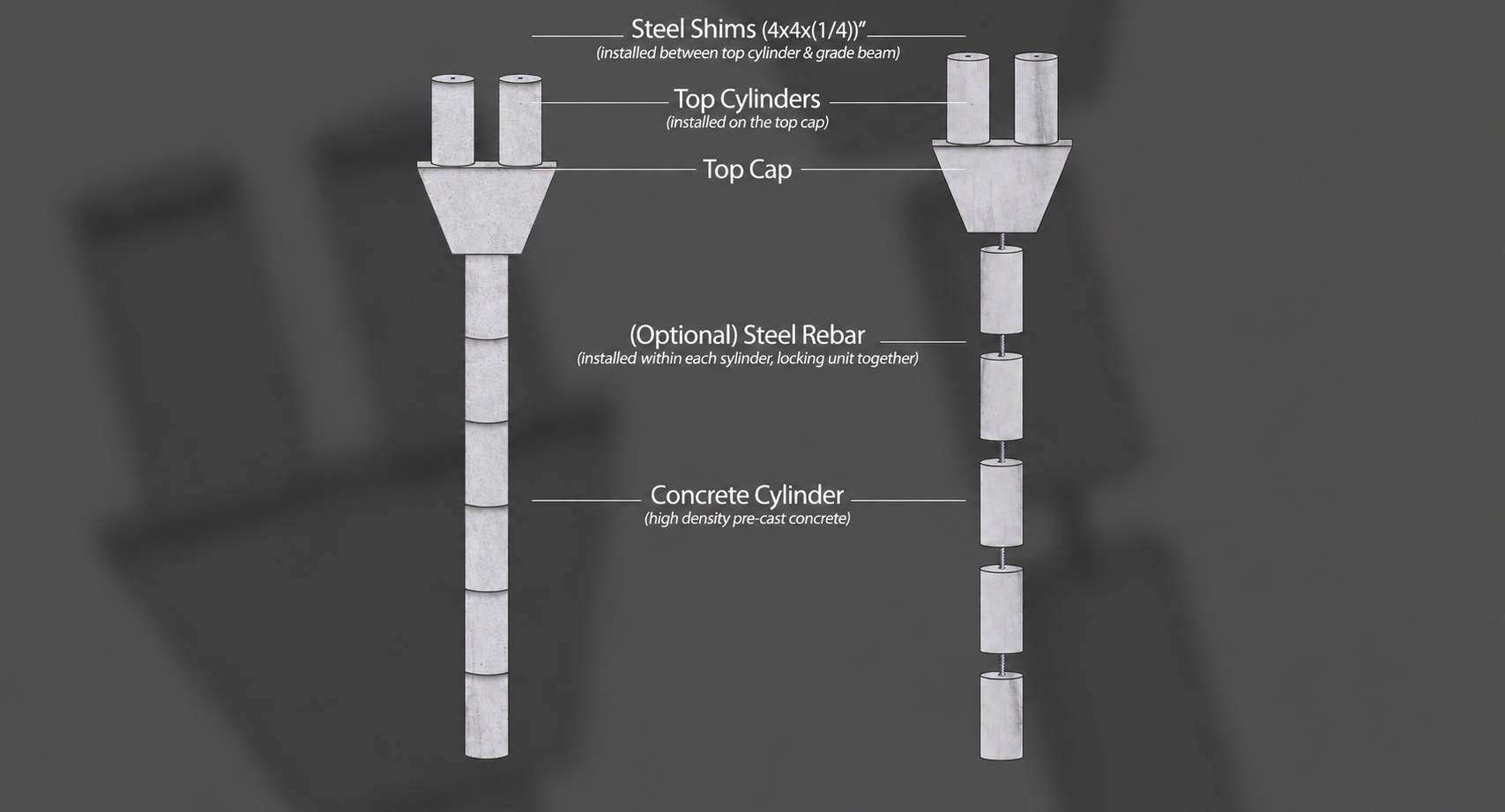
Concrete piers have been used for decades to stabilize settling foundations. These piers are installed beneath the foundation by stacking precast concrete cylinders deep into the ground until they reach soil capable of supporting the home’s weight.
Benefits of concrete piers include:
Cost-effective foundation support
Proven repair method with a long history of use
Suitable for many residential foundation repairs
Durable materials that can withstand significant loads
Concrete piers can provide reliable stabilization when installed properly and under the right soil conditions.
Steel Pressed Piers
Steel pressed piers are designed to transfer the weight of a structure to deeper, more stable soil layers. During installation, steel sections are hydraulically driven into the ground beneath the foundation until they reach a load-bearing stratum.
Benefits of steel pressed piers include:
Greater depth potential than many concrete pier systems
High strength and load-bearing capacity
Effective for homes experiencing significant settlement
Reduced likelihood of future movement caused by unstable surface soils
Precise installation and load testing capabilities
Because steel pressed piers can often be driven deeper than concrete piers, they are frequently recommended for homes built on expansive or highly unstable soils.
Concrete Piers vs. Steel Pressed Piers
Both concrete and steel pressed piers are designed to stabilize settling foundations, but the best solution depends on factors such as soil conditions, the severity of settlement, and the structure’s weight.
Concrete piers are often an economical solution for many residential foundation repairs and have a proven track record in the industry.
Steel pressed piers, on the other hand, offer exceptional strength and can reach deeper load-bearing layers, making them a preferred option for more challenging foundation conditions.
A professional foundation inspection is the best way to determine which repair method is most appropriate for your home. An experienced foundation specialist can evaluate the soil conditions, measure foundation movement, and recommend a solution designed to provide long-term stability.
Benefits of Foundation Pier Systems
Foundation piers offer several advantages for homeowners dealing with foundation settlement:
Long-Term Stability
Piers reach deeper, more stable soil layers that are less affected by seasonal moisture changes.
Prevent Further Damage
Stabilizing the foundation helps stop additional settlement and structural movement.
Potential Foundation Lift
Depending on the condition of the structure, some homes can be partially restored toward their original elevation.
Protect Property Value
Addressing foundation issues promptly can help preserve the value and marketability of your home.
Durable Materials
Modern pier systems are designed to provide decades of reliable performance.
Are Foundation Piers Worth It?
Foundation settlement rarely improves on its own. In fact, waiting often allows the problem to worsen, leading to larger cracks, increased structural damage, and more expensive repairs.
Foundation piers address the underlying cause of settlement rather than simply covering up visible symptoms. For many homeowners, they represent one of the most effective and permanent foundation repair solutions available.
Schedule a Professional Foundation Inspection
Every home and foundation problem is unique. The best way to determine whether foundation piers are right for your property is through a professional evaluation.
At Pro-Select Foundation Repairs, our experienced team carefully assesses foundation movement, identifies the root cause of settlement, and recommends the most effective repair solution for your home.
If you’ve noticed cracks, uneven floors, sticking doors, or other signs of foundation trouble, contact Pro-Select Foundation Repairs today at (817) 542-0313 to schedule a comprehensive foundation inspection and protect your home for years to come.
